Minus Eighty and Holding: The Quiet Infrastructure That Keeps a Decade of Samples Alive
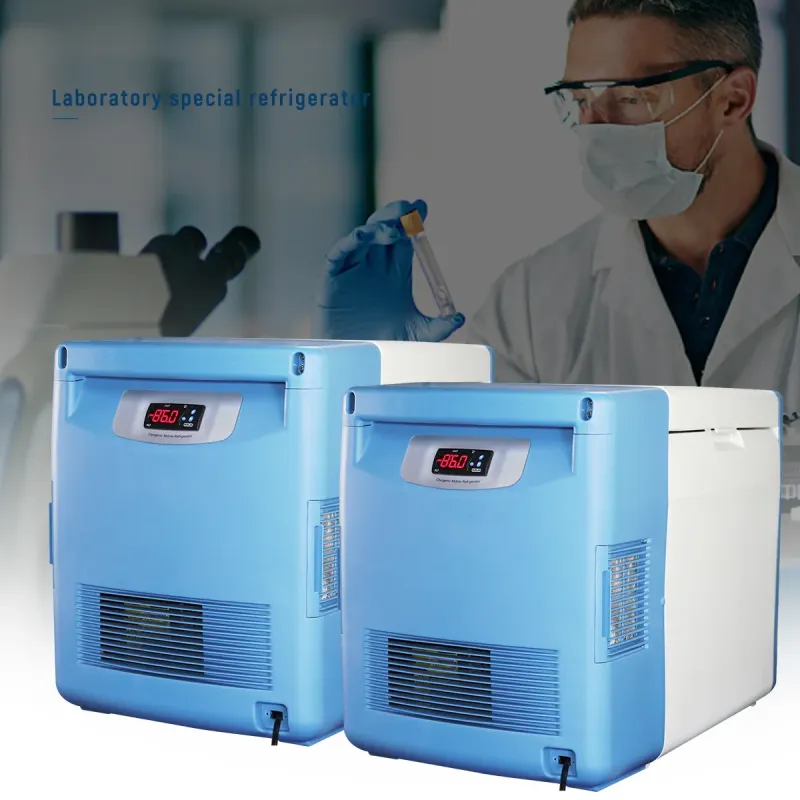
Photo: laboratory ultra-low temperature freezer with cryogenic sample boxes, via img4.dhresource.com
Visitors to the lab rarely ask about the freezers. They ask about the microscopy, the sequencing runs, the latest Western blots pinned to the cold room door. Yet if you asked any senior member of McKnight Lab what our most valuable asset is, the answer would not be an instrument or a grant. It would be the racks of cryovials resting at minus eighty degrees Celsius—cell lines derived over a decade, antibody lots that no longer exist commercially, and purified constructs that took months to generate.
This article is an account of how we protect them, written in the hope that other labs, especially those just starting out, will treat sample stewardship as a discipline rather than an afterthought.
What Is Actually at Risk
A modern -80°C ultralow freezer is a marvel of engineering, but it is also a single point of failure. Compressors wear out. Gaskets degrade. Power interruptions happen during storms, and in the American Northeast we have seen more of those in recent years than any of us would like. When a freezer fails, the clock starts immediately: interior temperatures can climb above the survivable threshold for many cell lines within a few hours.
The contents, however, cannot be replaced on that timeline. Some of our lines trace back to a postdoctoral fellow who left the lab in 2015. The original patient-derived material, the transfection records, the characterization data—these exist only because someone decided, years ago, that the vials deserved redundancy.
Our Three-Tier Storage Protocol
Our approach is deliberately unglamorous. It rests on three principles.
First, duplicate everything critical. Every essential cell line is split into at least two independent freezers, physically separated in different rooms on different electrical circuits. A single compressor failure, or even a single circuit breaker trip, cannot take out both copies. For our most irreplaceable lines, we maintain a third stock at a core facility across campus.
Second, log and map obsessively. Each box position is recorded in a shared inventory database, with backup printed inventories taped inside the freezer room door. When someone needs a vial at 2 a.m. during a thaw cycle, ambiguity is the enemy. We audit the inventory twice a year, reconciling physical contents against the database and discarding empty or expired entries.
Third, monitor continuously and remotely. Every unit carries an independent temperature logger with alarm thresholds that trigger text messages and calls to designated lab members. The alarm system runs on battery backup and a separate cellular connection, so it works even when building power and Wi-Fi do not. We treat alarm tests like fire drills: scheduled, documented, and occasionally surprising in what they reveal.
Disaster Recovery: Planning for the Bad Night
Protocols matter most on the night something goes wrong. Ours specifies, in writing, who responds to an alarm, how quickly, and what they do. Backup dry ice is contracted through a local supplier with a guaranteed delivery window. A liquid nitrogen dewar in an adjacent room serves as emergency transfer storage for our most sensitive stocks. The response plan is posted inside the freezer room and reviewed with every new lab member during onboarding.
We also rehearse. Once a year, we run a tabletop exercise: the freezer in room 412 has failed at 11 p.m. on a holiday weekend. Who gets called? What transfers first? The exercise costs an hour; the alternative could cost a decade.
Budgeting for Resilience
None of this is free, and we are candid about that with collaborators and with our department. Independent monitoring systems, maintenance contracts, dry ice subscriptions, and backup storage fees are real line items. Our rule of thumb: budget roughly one to two percent of annual operating funds for cryostorage infrastructure and treat it as non-negotiable, the way one treats centrifuge maintenance or chemical safety compliance.
When writing grants, we frame these costs as data preservation. A failed freezer does not just lose samples—it loses the reproducibility foundation for every paper those samples support. Reviewers, in our experience, respond well to that framing.
A Culture, Not Just a Checklist
The deepest layer of protection is cultural. New members learn early that freezer duties are shared, that inventory updates are part of finishing an experiment, and that reporting a temperature wobble promptly is rewarded rather than blamed. Sample stewardship is a form of respect—for colleagues past who created the stocks, and for colleagues future who will depend on them.
The freezers hum along, mostly unnoticed. That is exactly how it should be.