From Whiteboard to Accepted Manuscript: The Real Lifecycle of an Experiment at McKnight Lab
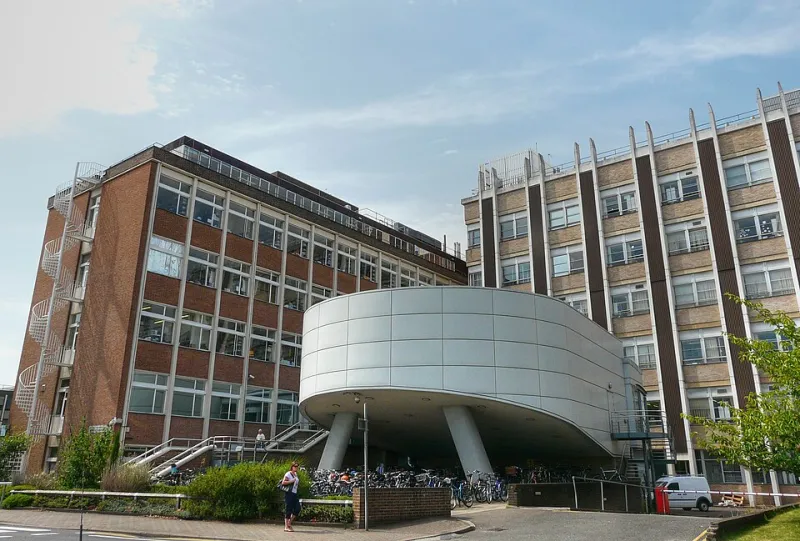
Photo: Jynto (talk), Public domain, via Wikimedia Commons
Students often encounter published papers as polished, inevitable narratives: hypothesis, methods, results, conclusion. The reality inside a molecular biology laboratory looks considerably messier. At McKnight Lab, we believe that demystifying this process is one of the most valuable things we can offer undergraduates considering a career in research. What follows is an honest account of how an experiment moves from an idea scribbled on the whiteboard to a manuscript accepted by a peer-reviewed journal.
It Begins With a Question, Not a Hypothesis
Before we ever formalize a hypothesis, we start with a question rooted in the literature. During our weekly journal clubs, someone inevitably asks, "Why does this paper's model break down under condition X?" Those questions are the raw material of our research program. Only after extensive reading and discussion do we narrow a broad question into a testable, falsifiable hypothesis.
We require every new trainee to write a one-page rationale before touching a pipette. It forces clarity: What are we predicting? What result would contradict our expectation? What is the simplest experiment that could settle the matter? In our experience, projects that skip this step tend to drift, consuming months of reagents and time without producing interpretable data.
The Pilot Phase: Small, Cheap, and Fast
Once a hypothesis survives scrutiny, we design a pilot assay. Pilots in our lab follow three rules: use minimal sample, use minimal budget, and set a clear go/no-go criterion in advance. A pilot might involve a single western blot with two conditions rather than a full dose-response curve, or a preliminary qPCR run with one primer pair instead of five.
The purpose of a pilot is not to generate publishable data — it is to learn whether the larger experiment is worth doing. Roughly a third of our pilots fail, and we consider that a success of the process. Every failed pilot saves us from investing months into an approach that was never viable.
Troubleshooting: Where Real Training Happens
When an assay underperforms, the troubleshooting phase begins. This is where junior scientists develop their craft. We maintain a shared lab notebook system, and every troubleshooting attempt gets documented: what was changed, why, and what happened. Our standard framework is simple — change one variable at a time, verify each reagent independently, and never assume the kit worked the way the datasheet promised.
Some of our most instructive failures took weeks to diagnose. One project stalled for two months because an antibody had degraded after repeated freeze-thaw cycles. Another produced baffling amplification curves until a rotating graduate student discovered that a shared thermocycler's heated lid was miscalibrated. Neither incident appears in our publications, but both permanently changed our lab's standard operating procedures.
Replication Before Celebration
A single clean result is a lead, not a finding. Before we treat any result as real, we require biological replication with independently prepared samples, ideally by a different lab member. This internal replication step has caught more artifacts than we can count — batch effects, carryover contamination, and once, memorably, a cell line whose identity no longer matched its label.
We also embrace the discipline of negative controls with near-religious seriousness. If a result only appears without proper controls, it does not appear at all in our records.
Writing, Submitting, and Responding
Manuscript preparation at McKnight Lab starts early — figures are drafted while the final confirmatory experiments are still running. We write the results section first, then methods, then discussion, and the introduction almost always last. Every figure must stand alone, and every claim in the text must trace back to a specific panel.
Peer review then begins. Reviewer comments can feel harsh, but we train students to treat them as free consultation from experts. Our most-cited paper improved dramatically after a reviewer pushed us to include an experiment we had initially considered optional.
Advice for Students Joining Their First Lab
Three habits will serve any new undergraduate well. First, document everything in real time — your memory is not a laboratory notebook. Second, ask questions early and often; the cost of a five-minute question is far lower than the cost of a wasted week. Third, treat failed experiments as data about your methods, not verdicts on your ability.
Research is a craft learned through repetition, error, and incremental improvement. The polished paper you eventually read is the visible tip of a long, occasionally frustrating, deeply rewarding process — and every scientist you admire once struggled through their first failed pilot, too.