The Front Row Is a Choice: What Seminar Questions Actually Signal to a Room Full of Scientists
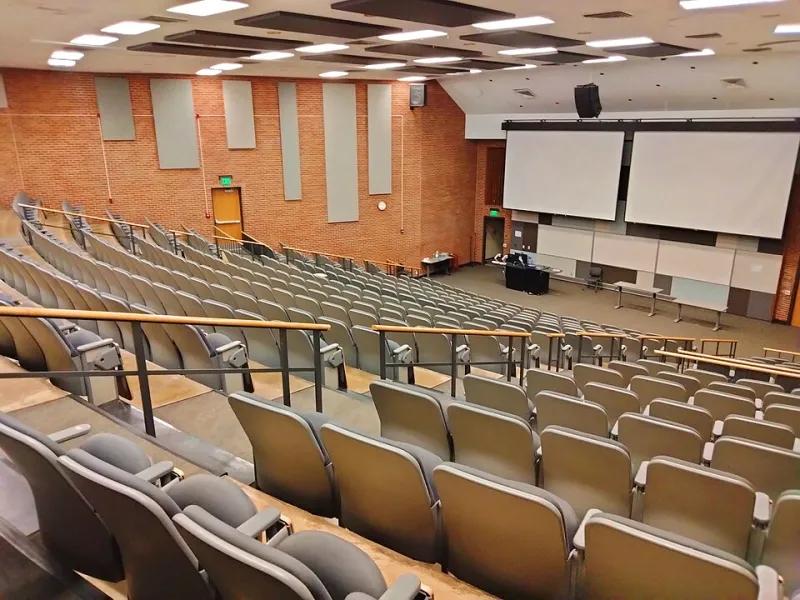
Photo: Garden Sprite, CC0, via Wikimedia Commons
Every departmental seminar in the United States follows a familiar rhythm: fifty minutes of slides, polite applause, and then the chair of the session leans toward the microphone and says the phrase that makes half the room reach for their notebooks and the other half check the time — "Are there any questions?"
For undergraduates and first-year graduate students, those final fifteen minutes can feel like a minefield. But at McKnight Lab, we've come to see the seminar Q&A as something else entirely: a rare, low-stakes public audition. A single well-constructed question can put your name in a visiting speaker's memory, prompt a hallway conversation, and — more than once in our own lab's history — open the door to a rotation spot or a summer collaboration.
Why Professors Watch the Questions, Not Just the Answers
We spoke with several principal investigators across molecular biology departments about which audience questions actually changed how they perceived a speaker — or, just as often, how they perceived the person asking.
The consensus was blunt. "I can tell within one sentence whether someone has engaged with the talk or is waiting for their turn to talk," one PI told us. "The questions that stay with me are the ones that take a specific result from slide twelve and connect it to a problem the speaker hasn't mentioned yet. That's not a performance. That's thinking in real time."
This matters for trainees because faculty routinely use seminars to scout. When a visiting speaker asks the host afterward, "Who was the student who asked about the controls?" — that is not a small thing. Rotation selections, thesis committee invitations, and collaboration inquiries have all started with less.
Reading the Room Before You Raise Your Hand
Not every seminar rewards the same kind of question. Before speaking, take thirty seconds to assess the situation:
- Who else is asking? If the first three questions are combative or self-promotional ("This is interesting, but my own work in a completely unrelated system shows..."), a genuinely curious question from a trainee stands out even more.
- What is the speaker's energy? A speaker who just got grilled on a technical point may welcome a question that gives them a chance to explain the bigger picture. A speaker who has been coasting may benefit from a sharper probe.
- What's the clock doing? If only five minutes remain, a long, multi-part question is a mistake. One question, clearly stated, always beats three tangled ones.
The Anatomy of a Question Worth Asking
The strongest questions we've observed tend to share a structure:
- Anchor in specifics. Reference an actual result, figure, or claim from the talk. "You showed that the knockout rescued the phenotype at 30 degrees but not 37 —" immediately signals attention.
- Add a small amount of your own thinking. This doesn't mean hijacking the question to talk about your project. A single clause — "I'm wondering whether the same logic would apply to the transcriptional readout" — is enough.
- End with a real question mark. It sounds obvious, but a surprising number of seminar "questions" are statements seeking applause. Actual uncertainty is more memorable than rehearsed cleverness.
A question you can build in real time: "You mentioned the effect was dose-dependent, but your assay saturates at the upper range. Do you think you're underestimating the response at the high end?" That question requires no insider knowledge — only that you paid attention and thought about the method's limits.
Performative Questions: A Taxonomy of Disasters
Every long-serving faculty member has a private archive of legendary question failures. The most common categories:
- The Hidden Monologue. Ninety seconds of personal research background followed by "...so, thoughts?" The room stops listening by second thirty.
- The Ambush. Questions designed to humiliate the speaker rarely land the way the asker intends. Senior scientists remember the ambush, not the cleverness — and they remember who asked it.
- The Housekeeping Question. "Could you go back three slides?" mid-Q&A wastes everyone's remaining time. Save logistics for afterward.
- The Absent Question. "I don't have a question, just a comment." Then make it a comment — silently, to yourself, or to the speaker at the reception.
One PI shared a story of a graduate student who opened a question with a full two-minute recap of their own unpublished data, only to forget what they were asking. "The speaker said 'great question,'" the PI recalled. "Nobody in the room knew what the question was. That's the risk of performance over substance — you can lose the thread of your own setup."
When Not to Ask — and What to Do Instead
There is no shame in staying quiet. If the room is full of specialists and you're a second-year undergraduate still building vocabulary, a forced question can do more harm than good. The alternative is often more effective: approach the speaker during the reception, introduce yourself, and ask your question one-on-one. Speakers overwhelmingly prefer this. They came to the department partly to meet people, and a student who says "I didn't follow the second half of your talk — could you walk me through the logic?" demonstrates more intellectual honesty than a polished but hollow public question ever could.
If the exchange goes well, close with a simple, concrete follow-up: "Would you mind if I emailed you about your lab's work?" Most will say yes, and most will remember the email when it arrives.
The Long Game
The uncomfortable truth about seminar questions is that their value compounds slowly. No single question will transform a career. But a trainee who asks one thoughtful question per month — in seminars, journal clubs, and chalk talks — develops a reputation as someone who engages. Three years later, that reputation is the reason a PI forwards your name when a collaboration needs a motivated student.
At our lab, we tell rotating students the same thing every year: the front row is a choice, the notebook is a choice, and the raised hand is a choice. Scientists notice choices. Make yours deliberately.