Fourteen Days on Paper: What a Mandatory Analog Window Taught Us About Honest Data
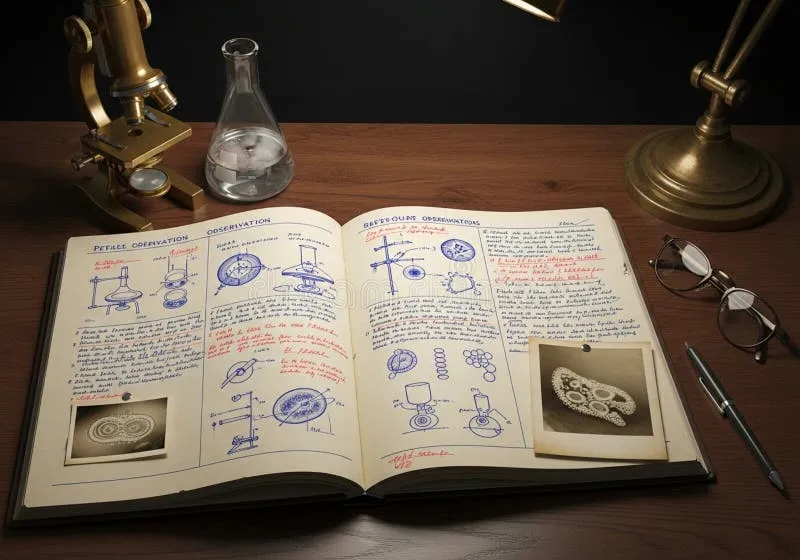
Photo: handwritten laboratory notebook with pen on bench next to microscope, via thumbs.dreamstime.com
Every laboratory has its rituals. Ours began as an accident.
In the fall of 2021, a shipment delay left one of our postdoctoral researchers, Dr. Priya Raman, without access to the electronic lab notebook (ELN) platform we had just licensed. Rather than pause her project, she started a plain composition notebook from the campus bookstore. When the platform came back online two weeks later, we sat down to transfer her records — and noticed something we had not seen in years of digital-only documentation: a troubleshooting trail that was unusually candid, unusually detailed, and, crucially, unusually useful.
That accident became policy. Today, every project at McKnight Lab begins with a single paper notebook that remains the sole system of record for the first fourteen days before anything is digitized. We call it the analog window. It is, by most modern standards, backward. We would argue it is the most valuable two weeks in our experimental lifecycle.
Why the First Two Weeks Matter Most
The opening phase of any molecular biology project is where the majority of silent errors are born: a mislabeled buffer, a forgotten control, a pipetting scheme that made sense at the bench and nowhere else. Digital systems, for all their searchability and version control, make it effortless to type what you meant to do. Paper makes that harder. You cannot paste a template entry into a notebook. You must write out the protocol by hand, and in that transcription, discrepancies surface.
We tracked this informally over eighteen months. During the analog window, our rate of caught-at-source errors — mistakes identified before they contaminated a dataset — rose noticeably compared to projects documented digitally from day one. The mechanism, we believe, is simple: handwriting is slow, and slowness buys scrutiny.
The Psychology of a Wasted Page
There is a second benefit we did not anticipate. In our ELN, a failed reaction often became a deleted draft or a terse "repeat — inconclusive." In a paper notebook, the failed attempt occupies a page whether you like it or not, and the convention we adopted requires that you annotate it rather than strike it through.
This has changed how junior researchers in the lab relate to failure. A new rotation student can open Priya's original notebook and read, in her own hand, the three consecutive Western blots that did not work and the exact reasoning behind each attempted fix. That document has done more to train incoming students than any protocol we have written. Failure, recorded honestly and permanently, becomes curriculum.
The Digitization Step Is Not Optional
We want to be clear about what this system is not. It is not a rejection of digital tools, and it is not a records-retention loophole. After fourteen days, every page is scanned, tagged, and uploaded to our ELN, where it joins the permanent, searchable, shareable record. The paper notebook then lives in a shelf in the lab commons, available for consultation but no longer authoritative.
The two-week window is a deliberate bottleneck, not an endpoint. Data that never gets digitized does not, in our lab, count as data. We made this explicit in our documentation standard after a near-miss in which a departing technician left behind a half-digitized notebook — an incident that prompted the shelf-location requirement and a weekly audit during active windows.
Would This Work Elsewhere? An Honest Assessment
We have fielded questions from collaborators about whether this is replicable or simply a quirk of our lab's size. The honest answer: it depends on throughput and team structure.
The analog window works best when a project is genuinely new — protocol development, pilot experiments, technique troubleshooting. For high-volume, routine workflows such as repeat genotyping or standardized assays, hand-copying entries adds friction without adding scrutiny, and we do not require it. Labs running dozens of parallel projects with rotating personnel may find that fourteen days of paper creates more handoff risk than it prevents.
What we would recommend universally is not the notebook itself but the principle behind it: build a period of deliberate slowness into the start of every project, and require that failures from that period survive into the permanent record. Whether that slowness comes from paper, a mandatory review checkpoint, or a read-only drafting stage in your ELN matters less than the fact that it exists.
A Note on Openness
Because our notebooks are digitized and shared with collaborators under our open-science practices, the analog window has an external benefit as well: the records that leave our lab are richer. Reviewers of our recent collaborative manuscript remarked on the unusually complete troubleshooting appendix. That appendix existed because fourteen days of paper made the failures impossible to omit.
We do not claim the analog window is the future of laboratory documentation. We claim only that it made us slower, more honest, and harder to fool — including by ourselves. In a field racing toward full automation, there is worse advice than to pick up a pen for two weeks and see what you have been typing past.