A Closet That Passes the Swab Test: Building a PCR Clean Zone for Under $3,000
Low-input PCR has a way of making ordinary bench work feel like a forensic exercise. A single stray amplicon can outcompete a scarce template, and the failure often arrives without a useful error message. Earlier this year, our lab reached the point where a clean bench was no longer a convenience. We needed a dedicated space for low-input amplification, and we needed it without a renovation budget. The result was a storage closet roughly the size of a generous coat room, converted for less than $3,000 in materials and equipment, excluding staff time. It is not a clean room in the certified sense. It is a controlled workspace that can be tested, documented, and improved. That distinction matters.
The Problem With a Bench That Looks Clean
Most molecular biology labs have a bench that is treated as clean because it is separate from the main work area. The surface is wiped, the pipettes are labeled, and the reagents are kept in a drawer. None of those habits is meaningless, but none of them proves that the workspace is free of the specific nucleic acids that ruin a low-input reaction. A bench can be visually immaculate and still carry enough template carryover to produce a false positive. The question is not whether a space looks clean. The question is whether it has been challenged with a method that could detect the contamination you care about.
Our first attempt began with the usual interventions: a bleach wipe-down, a UV lamp, and a firm instruction to keep the door closed. The PCR failures continued. We had confused cleanliness with control. A closet has its own ecology. Air moves under the door, ceiling tiles leak dust, cardboard boxes hold dust, and every entry brings a new opportunity for amplicon carryover. We needed to treat the room as a small system, not as a shelf with a lock.
What $3,000 Actually Buys
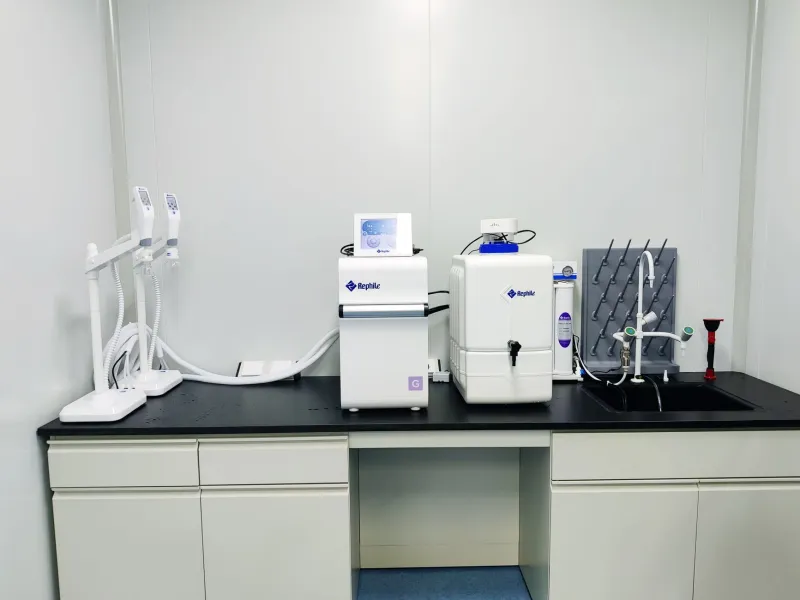
The final build was deliberately unglamorous. The largest single expense was a portable HEPA air filtration unit with a high-efficiency filter and enough airflow for the room's volume. We sealed the ceiling tiles, installed a door sweep, and replaced the hollow-core door's loose latch with a closer that made accidental propping less likely. A small wall-mounted light and a label printer helped enforce workflow, but they were not the point. The point was to reduce the routes by which material enters, accumulates, and moves back out.
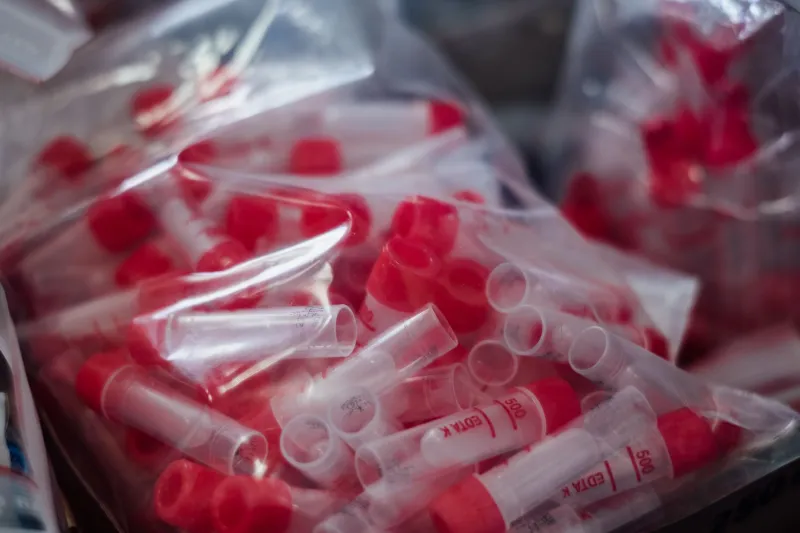
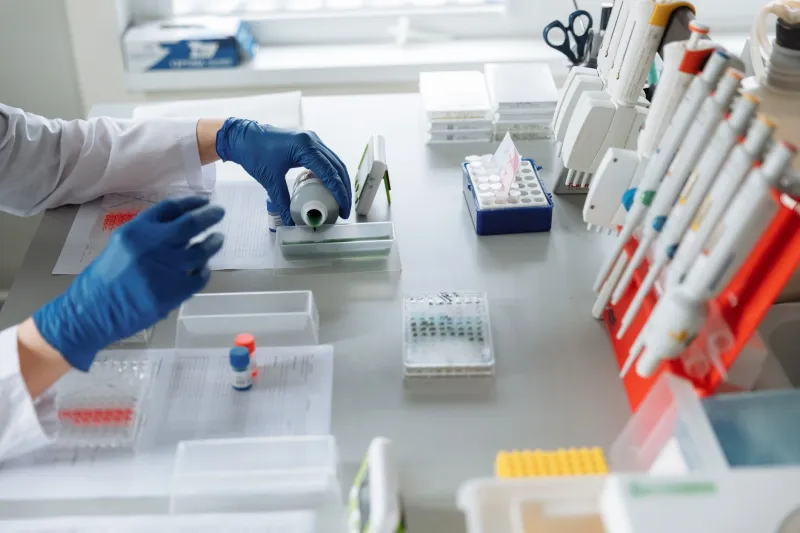
We bought two sets of dedicated pipettes, filtered tips, screw-cap tubes, and a small rack that stays in the room. Reagents are aliquoted outside the closet and brought in only for a defined session. Cleaning supplies are stored in a closed bin. A narrow bench liner covers the work surface and is replaced on a fixed schedule. The total came in under $3,000 because we did not buy a biological safety cabinet, a new HVAC system, or a prefabricated modular room. Those purchases may be appropriate for other labs. They were not available to us, and they are not required to improve control.
The important design choice was unidirectional workflow. Reagents and clean consumables enter on one side of the bench. Amplified products never return to the closet. Equipment that has touched post-PCR material does not come back in. This sounds simple, and it is simple in the same way that sterile technique is simple: it works only when every person follows it every time.
Air, Surfaces, and the Order of Operations
Air handling is usually where closet conversions go wrong. A portable HEPA unit helps, but only if the room is reasonably sealed and the unit is sized for the space. We measured the closet's volume, checked the filter's clean-air delivery rate, and placed the unit so that it did not blow directly across open tubes. We also stopped storing cardboard in the room. Cardboard is a dust reservoir, and dust is a vehicle. Plastic bins are easier to wipe and easier to inspect.
Surface cleaning follows a sequence rather than a mood. We remove visible debris, wipe with a detergent solution, then use a freshly prepared dilute bleach solution on surfaces that can tolerate it. We finish with nuclease-free water where residue could interfere with downstream work. We do not rely on UV as a primary decontamination method. UV reaches exposed surfaces poorly and creates a false sense of security around shadows, cracks, and the undersides of equipment.
Validation Is a Habit, Not a Certificate
The first validation attempt was also the first real lesson. We swabbed the bench after cleaning and ran qPCR for our target amplicon. The results looked excellent. They were also nearly meaningless, because we had swabbed only the surfaces we could see and had used a sampling buffer that was not adequately controlled. We had produced a comfortable number, not a credible one.
The revised routine samples the bench surface, the pipette barrels, the rack handles, the door handle, and the floor immediately inside the room. We include a swab of an untouched area as a field control, a no-template control for the qPCR, and an extraction control that travels through the same process as the samples. We record the cycle threshold values rather than reducing the results to pass or fail. A single clean swab is a data point. A monthly pattern is evidence.
We also test the workflow, not just the surfaces. A negative extraction control is run alongside every low-input batch, and a positive control is kept at the lowest concentration that reliably amplifies. If the negative control signals, the batch stops. That rule has been unpopular exactly once, which is probably the right number of times.
The Two-Month Detour
Our first two months were lost to three avoidable mistakes. We began with visual inspection and UV rather than target-specific swab testing. We sealed the door but overlooked the return-air path and the ceiling grid, so the room kept accumulating dust. And we validated immediately after cleaning, which answered the wrong question. A workspace is not clean because it can be cleaned. It is controlled because it stays controlled between sessions and because someone checks.
The delay was frustrating, but it produced a more useful outcome than a faster build would have. We now have a written entry routine, a cleaning log, a swab schedule, and a short onboarding checklist for anyone who uses the closet. The documentation is public in our lab protocol repository, including the budget and the parts we would not buy again. That is the open-science case for sharing a small infrastructure project: the useful information is often in the detours.
A Checklist for Suspicious Benches
Before trusting any bench described as clean, ask whether it has been tested against the contamination that matters. Does the validation target your actual amplicon, or only a generic nucleic acid stain? Are there field controls and no-template controls? Is airflow known, or assumed? Are pipettes dedicated to the space, and are their barrels sampled? Are reagents aliquoted outside the clean area? Does the workflow ever allow amplified product to re-enter? Is cleaning performed with a validated sequence, and is it logged? Most importantly, can the person using the bench explain what would happen if a negative control failed?
Our closet is not a certificate. It is a small, testable system that costs less to maintain than a failed experiment. For labs with limited space and limited budgets, that may be the most reproducible part of all.